
Dortmund vs Bayern Munich Tickets
Dortmund vs Bayern München billetter

 06-03-2027
Der Klassiker is Germany’s defining modern rivalry: not a local derby, not a family feud across neighbouring streets, but a fight for status, pride and domestic supremacy. Anyone looking for dortmund vs bayern munich tickets is stepping into something heavier than a normal Bundesliga game. On one side stands Dortmund: Ruhr emotion, collective force, yellow-and-black defiance. On the other stands Bayern Munich: record-champion confidence, institutional power and the permanent expectation of winning. That tension is what gives this fixture its edge.
Why Dortmund and Bayern Munich clash
Der Klassiker did not grow from shared borders or ancient neighbourhood anger. It became fierce because the same questions kept returning: who sets the standard in German football, and who has the courage to challenge it? The answer has often involved Borussia Dortmund and FC Bayern München, two clubs with very different ways of carrying themselves.
The Dortmund Bayern rivalry sharpened in the 1990s, when Ottmar Hitzfeld’s side rose from contender to direct threat. Dortmund’s Bundesliga titles in the middle of that decade changed the temperature. Bayern were no longer looking down at a hopeful challenger; they were staring at an opponent capable of overtaking them when it mattered most.
That is why the contrast feels so clear. Dortmund carry the sound and grit of the Ruhr, with mass support that turns belief into noise. Bayern carry Bavarian certainty, tradition and the “Mia san Mia” mentality: the idea that pressure is not a burden, but part of the club’s identity. In the Bundesliga, few meetings place those worldviews so directly against each other.
Dortmund and Bayern Munich in full voice
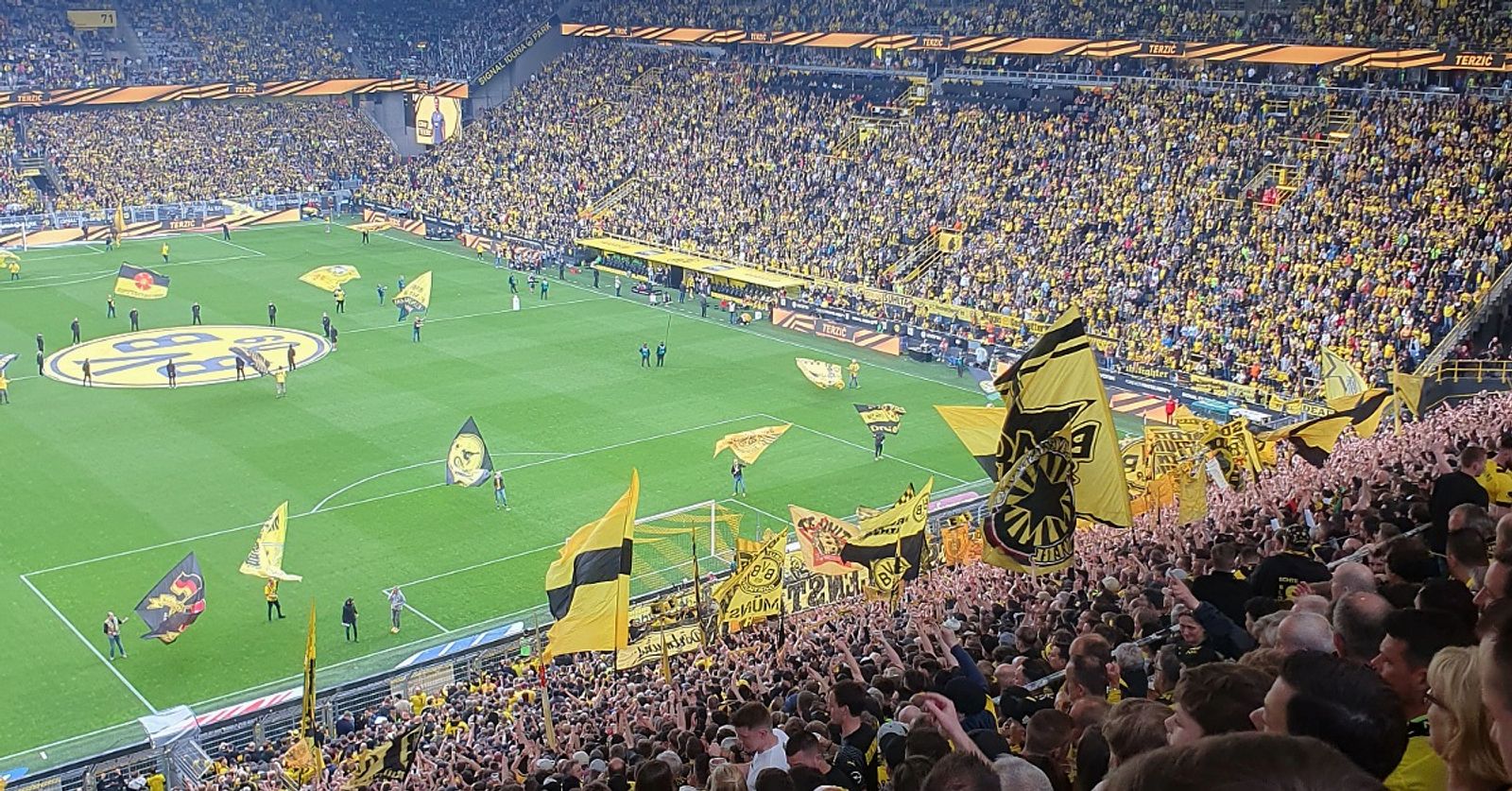
At Signal Iduna Park, still known to many as the Westfalenstadion, the Yellow Wall gives this contest a physical weight. The Südtribüne does not simply watch Bayern arrive; it pushes back. “You’ll Never Walk Alone” rolls around the ground, “Heja BVB” cuts through the air, and songs like “Leuchte auf, mein Stern Borussia” and “Am Borsigplatz geboren” remind everyone that Dortmund’s identity is built on belonging.
In Munich, the setting changes but the pressure remains. At the Allianz Arena, the Südkurve München brings the vocal edge to a club shaped by control and dominance. Bayern treat this meeting as a test of authority. Dortmund ask whether collective passion can shake the establishment. That is the heartbeat of Borussia Dortmund vs Bayern Munich: two football cultures pressing against each other until the evening feels electric.
Bayern Munich and Dortmund’s defining nights
Some moments turned this fixture from a sporting contest into a story with scars. In 1997 at the Westfalenstadion, Lothar Matthäus mocked Andreas Möller with a crying gesture. Möller reacted by putting a hand to Matthäus’ face. It was theatrical, tense and unforgettable, a flashpoint that pushed competitive heat into open hostility.
The same year, Dortmund won the Champions League against Juventus at the Olympiastadion. The symbolism was impossible to miss: BVB conquered Europe on Bayern territory. It gave Der Klassiker another layer, because Dortmund had not only challenged Bayern at home; they had announced themselves on the grandest club stage.
Then came the 2013 Champions League final at Wembley, the night Der Klassiker belonged to the world. Manuel Neuer saves, Mario Mandžukić’s opener, İlkay Gündoğan’s penalty, Neven Subotić’s desperate clearance and Arjen Robben’s late winner all became part of Bayern vs Dortmund history. For Bayern, it was redemption. For Dortmund, it was proof that their force could travel far beyond Germany. And for everyone watching live, it showed why this meeting still carries a charge that ordinary fixtures cannot imitate.