
German Football Guide: Teams, Stadiums, and Fan Culture
Scarves on trains, beer halls filling early, terraces singing long before kick-off, city weekends shaped around the game. That is the pull of German football. A football trip to Germany is rarely only about 90 minutes; it is stadium noise rolling through concrete, local food eaten standing up, regional pride on every platform, easy public transport, and a supporter culture that still feels close enough to touch. At Football Travel, we have helped more than 50,000 travelers since 2008 build trips around clubs, cities, and unforgettable football weekends, and this guide is for the dreaming phase: choosing the right club, the right timing, the right rituals, and the practical route before committing to one destination.
German stadium culture has a way of making the whole city feel involved. In Dortmund, yellow shirts gather before lunch. In Munich, the old town smells of roasted pork and malt before the U-Bahn fills. In Frankfurt, the walk through the trees turns the approach into part of the memory. Whether you are chasing a Bundesliga weekend, a derby, or a European night, the best trips begin with knowing what kind of football rhythm suits you.
When to plan the trip
If you want the fullest version of the Bundesliga fixture calendar, start with domestic league games. These are often when standing areas are at their loudest and most crowded, with songs rolling from the supporter blocks long before the players appear. European or international evenings can be spectacular too, but capacity may be reduced when terraces are converted to seating, so the feel can change slightly even when the noise remains fierce.
For raw emotion, few occasions in German football match the Revierderby. The meeting between Borussia Dortmund and Schalke 04 is the Ruhr’s great local clash: mining heritage, family loyalties, yellow against blue in stations, bakeries, and street corners. Der Klassiker, between Dortmund and Bayern, brings global attention, but the Revierderby feels like a region holding its breath.
European nights bring another flavour. Eintracht Frankfurt have built a reputation for loyalty that travels as loudly as it sings at home, especially after around 30,000 Frankfurt fans made their way to Camp Nou in 2022. A European night in the forest around Deutsche Bank Park can feel less like an event and more like a shared local ritual.
Choose the right club feel
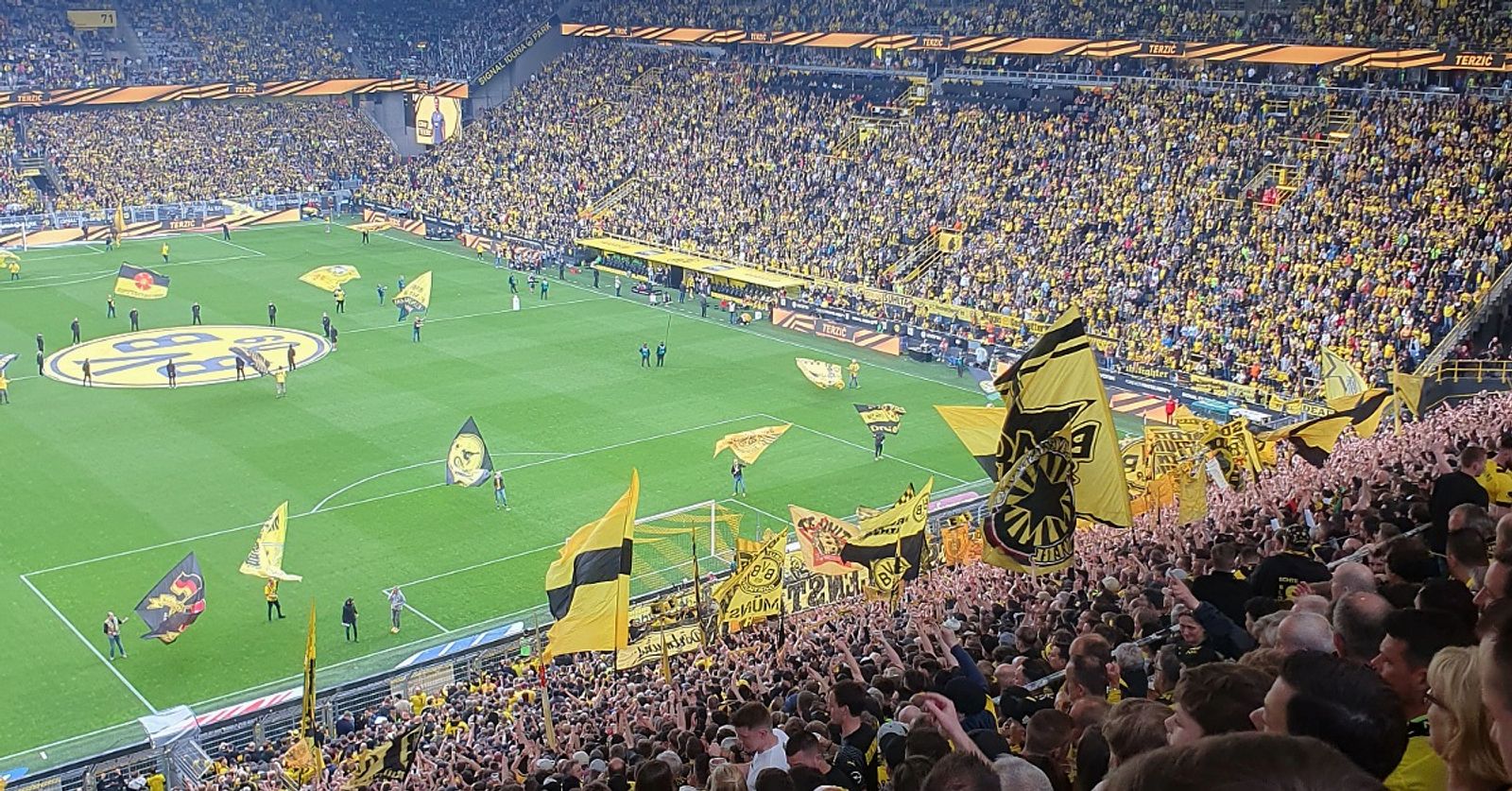
Dortmund suits travelers chasing the full wall-of-sound moment. The walk toward Signal Iduna Park is all black, yellow, smoke, and songs, before the Yellow Wall rises with 24,454 standing supporters behind one goal. When “You’ll Never Walk Alone” fills the ground, even first-time visitors tend to stop talking for a while.
Munich has a different rhythm. A Bayern München weekend can begin in a wood-panelled hall near the centre, with steins on long tables and pretzels passed between friends, before the U6 carries red shirts north to Fröttmaning. The Allianz Arena glows on the edge of the city, and Bayern’s home league sell-out run since January 2007 tells you how deep the habit runs.
For something more compact, Bayer Leverkusen works beautifully as a Rhine-region escape. You can base yourself near Cologne or Düsseldorf, travel in easily, and feel close to the pitch at the BayArena. The unbeaten 2023/24 champions added a fresh chapter to a club that now attracts curious neutrals as well as devoted locals.
Feel the pre-kick-off rituals
The hours before the game often decide how you remember the trip. In Dortmund, start around Alter Markt or Kreuzviertel, where glasses clink on outdoor tables and bratwurst smoke hangs in the air. Then drift with the yellow-and-black flow toward Strobelallee, past scarves in station tunnels and the first drums near Strobels, with the Yellow Wall at Dortmund waiting beyond the turnstiles.
In Munich, the build-up is calmer but no less satisfying. Eat in the old town or settle into Hofbräuhaus or Augustiner-Keller, where the room hums with several languages and the clatter of plates. Then take the U6 north with Bayern shirts pressed shoulder to shoulder. For many travelers, the beer-hall rhythm before Bayern is as much a part of the day as the anthem.
Frankfurt is all about contrast. Try Apfelwein in Sachsenhausen, sharp and sour in the glass, then take the S-Bahn to Stadion and walk 10 or 15 minutes through the trees toward the old Waldstadion setting. The forest muffles the city, then releases you into floodlights and songs. It is one of the most distinctive approaches in German football culture, and Eintracht Frankfurt at Deutsche Bank Park makes full use of it.
Plan transport and official entry
Germany makes football trip planning feel refreshingly simple. Stay central, eat and drink in town first, then travel 90 to 120 minutes before kick-off for major fixtures. In Dortmund, use the Stadtbahn toward Theodor-Fliedner-Heim, Westfalenhallen, or Stadion; Theodor-Fliedner-Heim is around five minutes on foot from the ground. For Schalke, tram 302 runs from Gelsenkirchen Hauptbahnhof to the Veltins Arena in about 15 minutes, and home entry often includes VRR public transport.
Frankfurt is even quicker: the S7, S8, or S9 from Hauptbahnhof reaches Stadion in roughly six minutes, followed by that forest walk. Leipzig offers another easy route, with RB Leipzig and the Red Bull Arena sitting close enough to the centre to make the journey feel part of the city rather than a detour.
For peace of mind, use official access and check whether local transport is included, especially for sold-out games or derby evenings when queues can stretch after the final whistle. Our package trips combine flight, hotel, and official match ticket, and the ticket guarantee means you can focus on the weekend itself: the train carriage singing, the last snack before kick-off, and that first roar when the teams walk out.