
Inter vs AC Milan Tickets
Inter vs Milan billetter

 Feb 14, 2027
Inter vs AC Milan tickets open the door to the Derby della Madonnina, a rivalry unlike almost any other in Europe: two clubs, one ground, one Milanese identity split into black-blue and red-black. This is not simply a major Serie A fixture. It is a family argument, a workplace debate, a lifelong allegiance, and a shared home divided by colour, sound, pride, and memory.
Why Inter and AC Milan split
The Inter vs AC Milan rivalry began with the same football root. In 1908, a group broke away from Milan Cricket and Football Club, the club now known as AC Milan, to create Football Club Internazionale Milano. The name was not accidental. Inter was founded with an open identity, especially around the acceptance of foreign players, and “Internazionale” still carries that idea in every syllable.
Club lore places the founding meeting at Ristorante Orologio, Piazza Duomo 22, with 44 members involved. Giorgio Muggiani is remembered as the designer of Inter’s first crest, giving visual shape to a new side of the same footballing family. The first derby was played on 18 October 1908 in Chiasso, Switzerland, before the first official meeting followed on 10 January 1909.
Over time, folklore gave both clubs their social labels. AC Milan became linked with the casciavit, the “screwdrivers”, a nod to working-class identity. Inter were called the bauscia, often translated as “braggarts” or flashy city types. That old divide has largely faded, but it still lives in derby mythology. It gives extra flavour to Inter’s side of the rivalry and to AC Milan’s derby identity, two stories forever tied together.
Inter vs AC Milan at San Siro
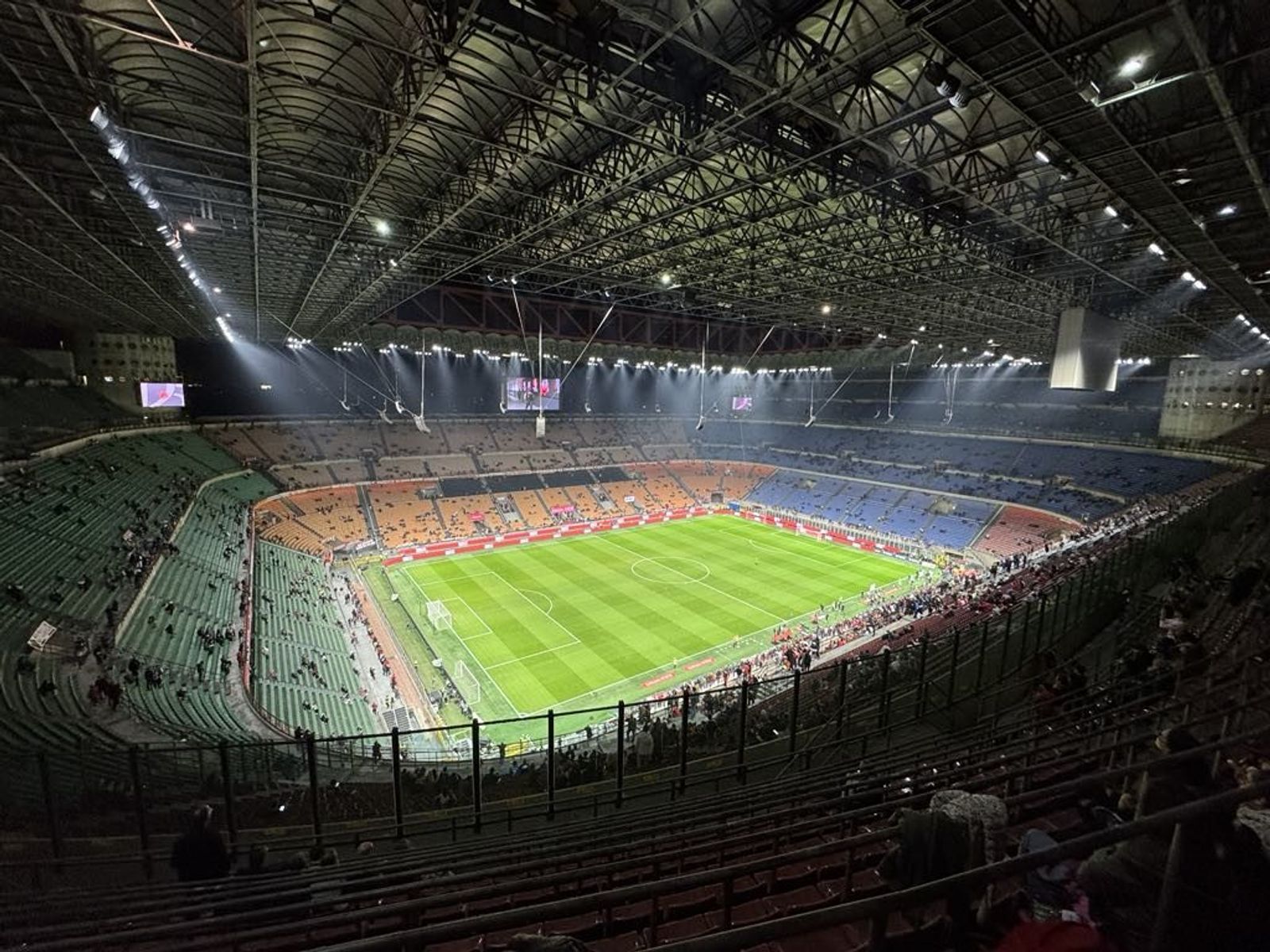
San Siro, officially Stadio Giuseppe Meazza, is what makes this fixture feel so intimate and so fierce. Both clubs call it home. There is no journey across town to enemy territory. The enemy is already there, behind the other goal, singing louder, waving different colours, claiming the same concrete bowl as their own.
On derby day, the ground becomes a theatre of separation. Nerazzurri and Rossoneri blocks face each other across the pitch. Inter’s loudest support is traditionally linked with the Curva Nord, while AC Milan’s most vocal backing comes from the Curva Sud. Long before kick-off, the first contest often appears in the coreografie: huge banners, mosaics, symbolic artwork, teasing messages, and sharp rival humour stretched across the terraces.
Then come the chants. “Chi non salta rossonero è” from one side, “Chi non salta nerazzurro è” from the other. The whole arena seems to bounce as allegiance becomes physical. The name Derby della Madonnina comes from the golden statue above Milan Cathedral, a civic symbol rather than a religious divide. It is the city’s image watching over a rivalry that belongs to both halves at once.
That shared setting is why Inter at San Siro and AC Milan at San Siro feel inseparable, even when the colours could not be further apart. It also explains why this fixture stands proudly among more iconic football rivalries.
Derby legends that never fade
The history of this clash is full of nights that still shape how both fanbases speak about it. Some results are remembered not just for the score, but for the wound, the comeback, or the look on the other end of the ground.
- On 6 November 1949, AC Milan built a major early lead, only for Inter to fight back dramatically through figures such as Amedeo Amadei and Benito Lorenzi. The lesson still feels true: no lead in this derby is ever completely safe.
- On 11 May 2001, Milan produced one of their proudest modern nights, with goals from Gianni Comandini, Federico Giunti, Andriy Shevchenko, and Serginho. For Inter, it remains a painful reference point; for Rossoneri supporters, a permanent source of pride.
- In the 2003 Champions League semi-final, both legs were played at San Siro, yet AC Milan advanced on away goals after Shevchenko scored in the second leg. Inter were knocked out by an “away” goal inside their own shared home.
The 2005 Champions League quarter-final added another unforgettable image, when flares and objects were thrown after an Inter flashpoint. It remains one of the most notorious European derby scenes, a reminder of how intense the Milan derby Champions League nights became.
That is the pull of the Derby della Madonnina. It carries origin stories, old class myths, European drama, terrace art, and everyday bragging rights into one evening. In the wider world of Italian league football and on European nights between giants, few fixtures feel this personal before the ball has even moved.