
Chelsea vs Arsenal Tickets
Chelsea vs Arsenal billetter



 13-03-2027
Chelsea against Arsenal is a London derby built on status, geography and memory. Blue from west London meets red from north London, with more than three points wrapped into every roar from the seats. The demand for Chelsea vs Arsenal tickets is shaped by pride, identity and decades of turning points, not simply by form. This fixture asks a bigger question: who carries the capital’s football authority?
Why Chelsea and Arsenal clash
The Chelsea and Arsenal story is not rooted in one single grievance. There is no neat origin myth, no one political split, no religious divide. Instead, the tension grew from a long-running argument over London identity: Chelsea pushing for equal or greater status, Arsenal defending tradition, seniority and capital prestige.
The first league meeting came at Stamford Bridge on 9 November 1907, when Chelsea beat Woolwich Arsenal 2–1. Even then, the interest around the game was huge. Contemporary newspaper coverage described the debate around it in the “family circle, club, workshop, office and factory.” That line still feels true. This is a fixture people talk about before it happens and keep arguing over long after the final whistle.
The contrast gives the rivalry its colour. Chelsea carry the swagger of the King’s Road, the blue shirts, the sense of a club that forced its way into the highest circles. Arsenal bring the older establishment image, the red, the memory of Highbury and a tradition of being one of the capital’s great reference points. From the late 1990s, the edge sharpened as both clubs chased major honours. After Chelsea’s rise as a trophy-winning force from 2003, the old balance shifted, and the Chelsea-Arsenal history gained a harder, more personal bite.
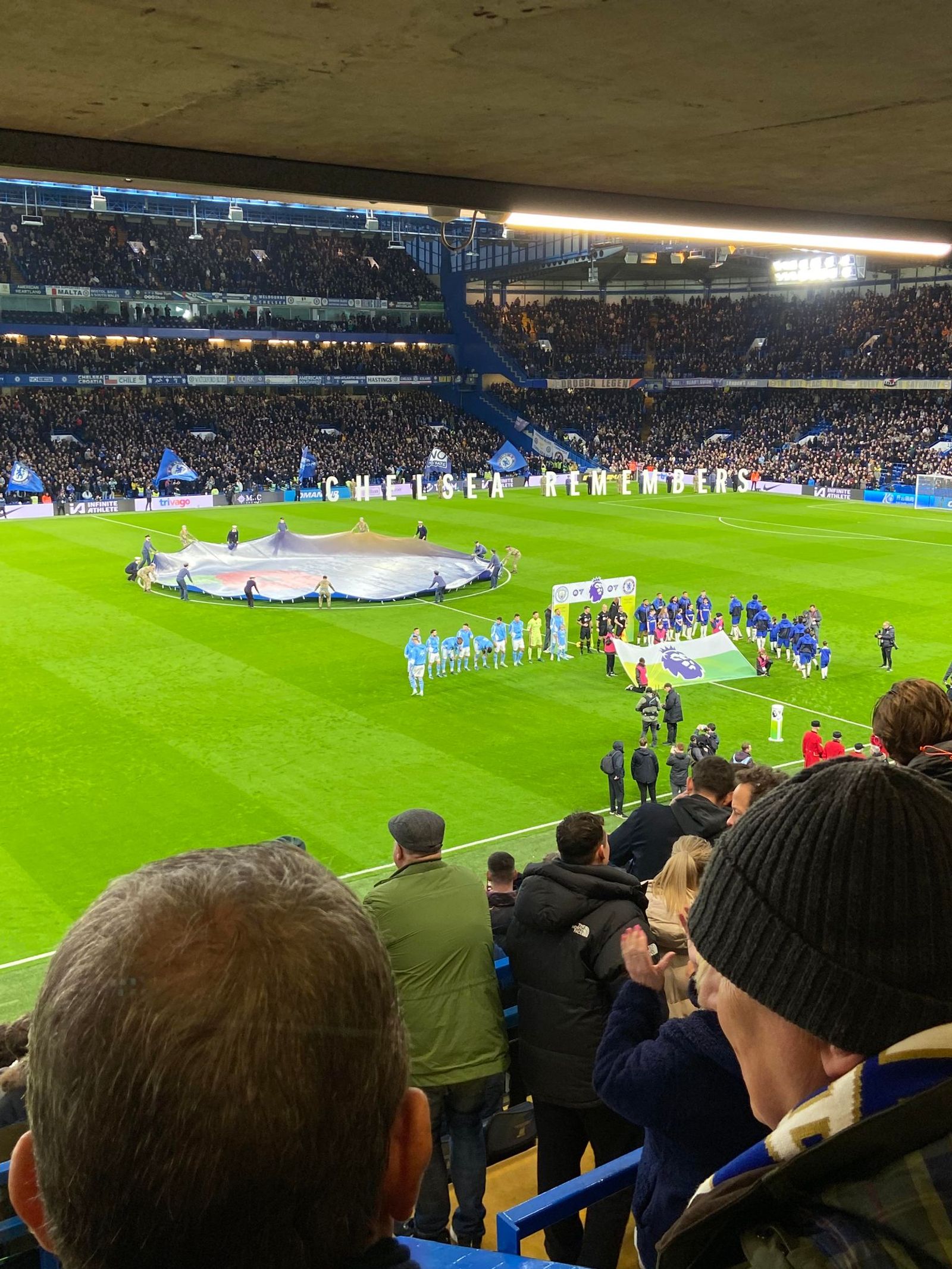
Chelsea vs Arsenal at Stamford Bridge
At Stamford Bridge, this meeting feels close, loud and unforgiving. The ground gives the game a compact intensity, with the away following adding sharp noise to every challenge, corner and near miss. It is not just a fixture on the Premier League calendar. It is a London football rivalry with a mood of its own.
The Bridge has long memories of this one. On 12 October 1935, Chelsea against Arsenal drew 82,905, the largest officially recorded crowd for any game at the ground. That number belongs to another era, but it says plenty about the pull of the contest.
The soundscape matters too. “Blue is the Colour,” created before the 1972 League Cup final, became tied to Stamford Bridge, the Shed and the King’s Road-era Chelsea image. “Carefree” carries a defiant mood, especially when the Blues feel surrounded or challenged. Arsenal bring their own echoes: “One-nil to the Arsenal,” linked to the George Graham years, and the heritage of the North Bank and Clock End, still carried from Highbury into the modern age. In emotional terms, Chelsea often see the game as proof of equality or superiority. Arsenal often see it as a defence of tradition.
Defining nights between blue and red
Some games changed how this rivalry felt. They turned London pride into trophy-era resentment, psychological drama and stories that still follow both clubs into every new meeting.
- On 6 April 2004, Chelsea won 2–1 at Highbury in the Champions League quarter-final. Arsenal were in an unbeaten league season, but Frank Lampard equalised after half-time and Wayne Bridge scored late. Chelsea reached their first semi-final in the competition and stepped out of Arsenal’s shadow on a European stage.
- On 25 February 2007, Chelsea beat Arsenal 2–1 in the League Cup final in Cardiff. Theo Walcott scored his first Arsenal goal, Didier Drogba answered with two of his own, John Terry suffered a serious injury scare, and a late brawl brought red cards for John Obi Mikel, Kolo Touré and Emmanuel Adebayor.
- On 29 October 2011, Arsenal won 5–3 at Stamford Bridge, with Robin van Persie scoring a hat-trick and John Terry’s slip becoming part of derby folklore. It remains a reminder that control can turn into chaos very quickly in this fixture.
That is why Chelsea Arsenal at Stamford Bridge still feels bigger than an ordinary game. It is status against status, memory against memory, west London against north London. The shirts, the songs and the old wounds all arrive before kick-off, and once the noise rises, the past never feels far away.