
AC Milan vs Inter Tickets
Milan vs Inter billetter

 31-10-2026 20:45
Choosing AC Milan vs Inter tickets means stepping into the Derby della Madonnina, a rivalry that feels less like two opponents meeting and more like one family arguing across the dinner table. Red and black face blue and black inside San Siro, and both sides claim the same ground, the same memories, and the same right to define Milan. This is AC Milan vs Inter at its purest: two cousins, never strangers, fighting over pride, belonging, and the voice of the city. We’ve helped over 50,000 travelers make the most of a football trip like this, and every booking comes with our ticket guarantee.
Why AC Milan and Inter split
The roots of the AC Milan Inter rivalry go back to Milan Cricket and Football Club, founded in 1899. The split came in 1908, when disagreement grew over whether foreign players should be welcomed. On 9 March that year, the breakaway group founded F.C. Internazionale Milano, built on the idea that Milan deserved “an international team.” Its founders were often described as students, immigrants, and artists, giving Inter an identity that was open by name and nature.
That is why the Milan derby origins feel so intimate. AC Milan and Inter did not grow up as distant enemies. One was born from the other. The old folklore adds another layer: Milan supporters were once linked with the working classes and nicknamed casciavit, “screwdrivers,” while Inter followers were associated with wealthier circles and called bauscia, “braggarts” or “show-offs.” That divide has largely faded since the 1970s, but the nicknames still sting, tease, and echo through derby culture.
The name Derby della Madonnina is not about religion as the source of hostility. It comes from the golden statue on the Duomo, watching over Milan from above. Under that symbol, the two clubs have argued for generations about who truly carries the city’s soul. For more context around the wider world of football rivalries, the great derbies all have their own fire, but this one is uniquely personal.
When San Siro turns into two worlds
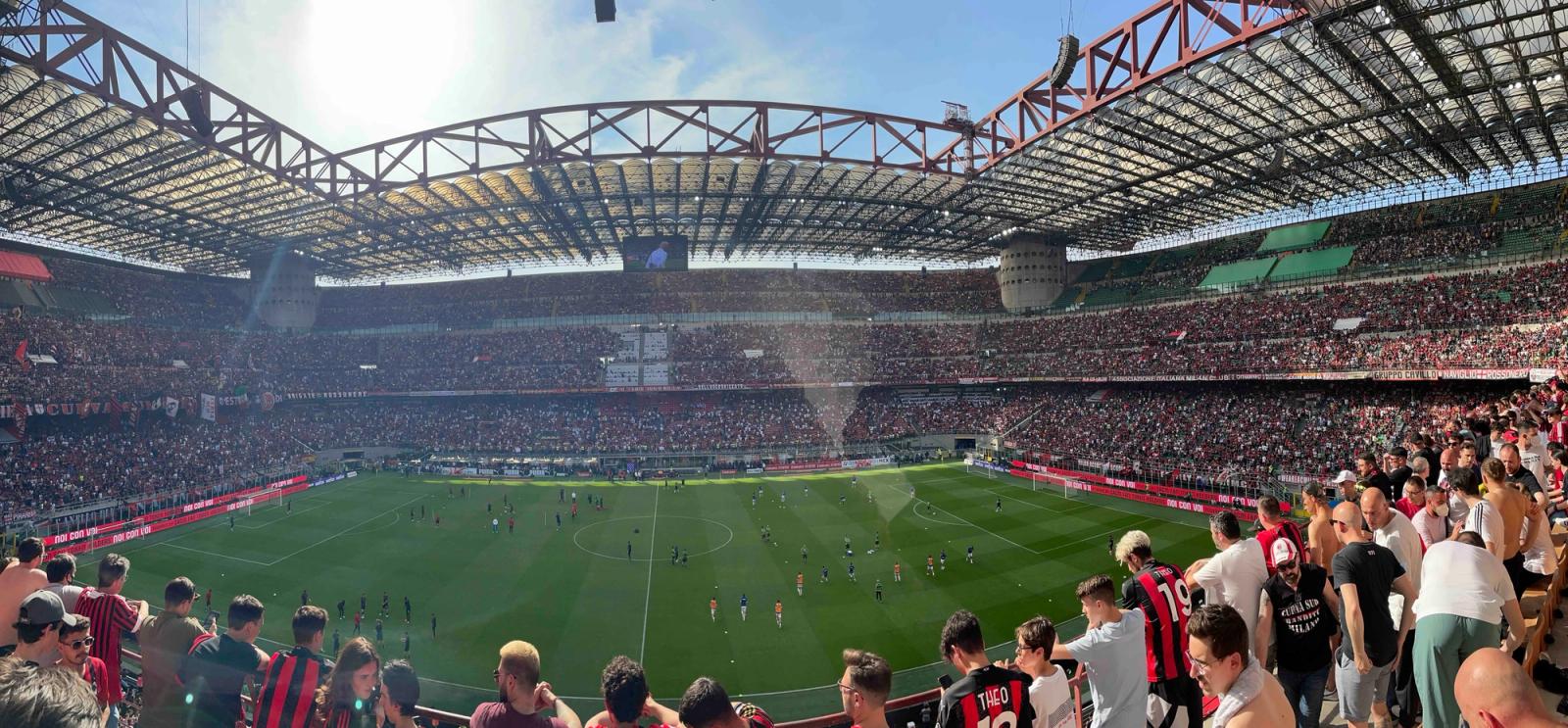
The San Siro derby has a special shape because both clubs traditionally share San Siro, also known as Stadio Giuseppe Meazza. Even when one side is officially at home, the emotional map rarely changes. Milan’s organised support gathers in Curva Sud. Inter’s organised support answers from Curva Nord. Across the same pitch, a red-and-black wall stares down a blue-and-black wall, and the game seems to begin long before the ball moves.
The pre-game ritual is a contest of imagination. Giant tifos rise. Flags ripple. Drums roll like thunder under the roof. Chants bounce from one end to the other, full of loyalty, humour, insults, and old wounds. Milan devotion can be heard in songs such as “Forza Diavolo alè,” while Inter faith travels through anthems like “Giro l’Italia per te.” The result is not just noise. It is identity made visible.
- One half of the ground claims the devil’s colours, while the other answers with black and blue.
- Every banner carries a message, a joke, a warning, or a memory.
- The real prize is bragging rights at home, at work, and in every family split by the two shirts.
That is why the Serie A setting feels secondary for a moment. This fixture is about the deeper claim to being the true voice of Milan. For many supporters, a Milan derby live is not simply watched. It is endured, sung, argued, and remembered.
AC Milan and Inter history makers
Some results become part of the language of the rivalry. On 11 May 2001, Inter 0–6 AC Milan became one of the defining Milanista bragging points. It was not only a heavy defeat; it was public humiliation inside the shared stadium. The scoreline turned into emotional currency, repeated in chants, jokes, family arguments, and derby banter for years.
Then came the Champions League “Euroderby” of 13 May 2003, part of a semi-final played entirely at San Siro. The first leg ended 0–0, but the away-goals rule still applied despite both games taking place in the same arena. In the second leg, Andriy Shevchenko scored the decisive “away” goal for Milan. Obafemi Martins equalised late for Inter, and Mohammed Kallon almost changed everything, only for Christian Abbiati to stop his chance with his knee. Milan remember destiny. Inter remember agony by inches.
The Champions League nights added another unforgettable image in 2005, when a quarter-final was abandoned after flares and objects were thrown, one striking Dida. Rui Costa and Marco Materazzi standing together amid the smoke remains a haunting frame: beauty, theatre, fury, and the warning of what happens when intensity goes too far. That is the Derby della Madonnina: magnificent, fragile, and impossible to ignore.